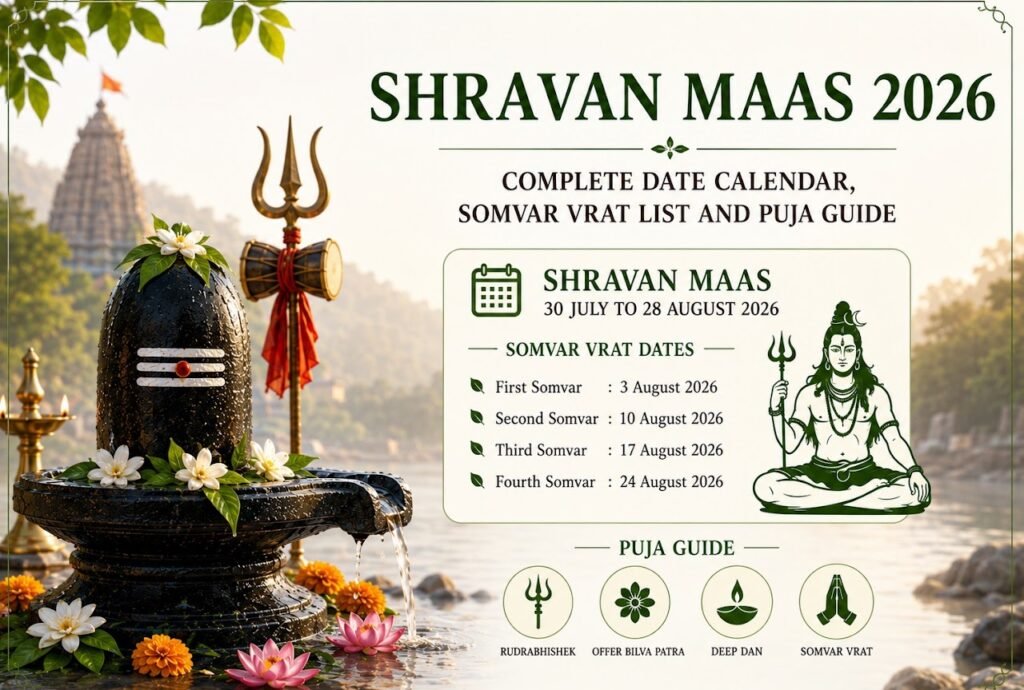
Shravan Maas 2026: Complete Date Calendar, Somvar Vrat List and Puja Guide
Ask any Shiva devotee what their favourite month of the year is, and most will say Shravan without a second thought. The rains arrive, the temples fill up, and for one full month, everything else takes a back seat to Mahadev.
This guide gives you the exact Shrava n Maas 2026 dates, the Somvar Vrat list, the story behind why this month belongs to Shiva, and the puja vidhi devotees have followed for generations. We have also shown where you can book Rudrabhishek online at Kashi Vishwanath, Kedarnath, Trimbakeshwar and Mahakaleshwar through Vedaangam, in case travelling this year is not possible.
When Does Shravan 2026 Begin and End
North India and South India do not celebrate Shravan on the same dates. This confuses a lot of people every year, so let’s clear it up first.
In Uttar Pradesh, Bihar, Rajasthan, Madhya Pradesh, Delhi, Punjab, Himachal Pradesh, Uttarakhand, Chhattisgarh and Jharkhand, Shravan Maas 2026 runs from 30 July to 28 August 2026. These states follow the Purnimanta calendar, where a month ends on the full moon.
In Maharashtra, Gujarat, Karnataka, Andhra Pradesh, Telangana, Tamil Nadu and Goa, the month runs from 13 August to 11 September 2026. These states follow the Amavasyant calendar instead, where the month ends on the new moon.
Neither calendar is wrong. They just count the month differently. The moon phases, the tithis, stay the same across India. At Vedaangam, our pandits and temple tie-ups follow the Purnimanta system used in Kashi, so that is what we go by through this guide.
Shravan Maas 2026 Date Table by Region
| Region | Calendar | Shravan Start | Shravan End |
| UP, Bihar, Rajasthan, MP, Delhi, Punjab, Uttarakhand | Purnimanta | 30 July 2026 | 28 August 2026 |
| Maharashtra, Gujarat, Karnataka, Andhra Pradesh, Telangana, Tamil Nadu, Goa | Amavasyant | 13 August 2026 | 11 September 2026 |
If you’re planning a Rudrabhishek at Kashi, go by the 30 July date. That’s when Kashi’s own Shravan begins, and pandit slots start filling up fast once the month opens.
Sawan Somvar 2026: Full Dates List
Every Monday in Shravan is called a Shravan Somvar. It’s the one day of the week when even people who don’t usually fast will keep an upvas and visit a Shiva temple.
North India gets four Shravan Somvars this year:
| Somvar | Date |
| First | 3 August 2026 |
| Second | 10 August 2026 |
| Third | 17 August 2026 |
| Fourth | 24 August 2026 |
The third Somvar, 17 August, also happens to be Nag Panchami this year. Shiva wears serpents around his neck, so this overlap makes that particular Monday extra special for his devotees.
Maharashtra and Gujarat get their four Somvars on 17, 24, 31 August and 7 September.
These four Mondays are also the busiest days for Rudrabhishek bookings across all our Jyotirlinga pujas. If you want to book one in your family’s name, do it early. Slots at Kashi Vishwanath and Kedarnath tend to run out a few days before each Somvar. You can check dates and book through our Shravan Maas puja page.
The Scriptural Significance of Shravan Maas
Why does one whole month belong to Shiva? The answer goes back to one of the oldest stories in our shastras, the Samudra Manthan.
The Story of Neelkanth, from Shivmahapuran
Shivmahapuran tells us that the Devas and Asuras once churned the ocean of milk together, using Mount Mandara as the rod and the serpent Vasuki as the rope. They were after Amrit, the nectar of immortality. But before Amrit came out, the ocean gave up something far more dangerous first: Halahal, a poison strong enough to destroy all three worlds.
Everyone panicked. Nobody, Deva or Asura, could stand near it. Shiva stepped in. He took the poison in his hands and swallowed it, but held it back in his throat instead of letting it go further. His throat turned blue from the burn, and that is how he became Neelkanth.
The Devas rushed to pour Ganga jal over him to cool the heat. This happened during Shravan. That is the whole reason Jalabhishek and Rudrabhishek, pouring water and other sacred substances over the Shivling, are considered the strongest form of worship in this month. When you do Abhishek in Shravan, you’re really repeating what the Devas did for Shiva after he saved the universe.
Parvati’s Penance, from Skanda Purana
The second story is Parvati’s. In her earlier life as Sati, she gave up her life after her father Daksha insulted Shiva publicly. She was reborn as Parvati, daughter of Himalaya, and her love for Shiva did not go anywhere.
This time she wanted to earn him, not have him arranged for her. So she did tapasya through Shravan, eating little, sitting through the rain and the heat, thinking only of Shiva. He was moved, and he accepted her.
This is why unmarried women keep the Shravan Somvar Vrat, praying for a husband like Shiva, and married women keep it praying for their husband’s long life. Some go further and keep all sixteen Mondays, the Solah Somvar Vrat.
The Jyotirlingas and Their Shravan Puja Traditions
Twelve Jyotirlingas exist across India, but four of them see the heaviest Shravan crowds and have their own puja traditions worth knowing. Vedaangam connects you through verified Kashi-trained pandits, with your sankalp taken in your own name and gotra.
Kashi Vishwanath, Varanasi
Nowhere feels like Kashi in Shravan. The ghats fill with Har Har Mahadev from morning to night. Two rituals stand out here. Rudrabhishek, where the Shivling gets bathed in Gangajal, milk, honey, curd and Bilva leaves while Rudra mantras are chanted. And Bilva Archana, where Bilva leaves are offered one by one while your sankalp is read out. If you can’t make it to Kashi, book either one online and you’ll get a recording plus tirth prasad at home.
Kedarnath, Uttarakhand
Kedarnath sits high in the Himalayas and is both a Jyotirlinga and one of the Char Dhams. Its Shravan Rudrabhishek is done by the temple’s own priests. There is also Neelkamal Archana, where 108 blue lotus flowers, a flower Shiva is said to love, get offered one at a time while all 108 of his names are chanted. Given how hard the yatra is during monsoon, most devotees now do this puja online through Vedaangam instead of travelling.
Trimbakeshwar, Nashik
Trimbakeshwar has something no other Jyotirlinga has: three faces in one lingam, for Brahma, Vishnu and Mahesh. It’s also where the Godavari begins. Rudrabhishek here is especially known for Kaal Sarp Dosh remedies. If something has felt stuck for a long time, career, marriage, health, this is the Jyotirlinga most devotees choose first.
Mahakaleshwar, Ujjain
Mahakaleshwar is the only Jyotirlinga that faces south, and it’s famous for its Bhasma Aarti at dawn. Its Shravan Rudrabhishek follows the same strict Vedic method that has run here for centuries. Devotees often pick Mahakal specifically when they want to overcome fear, since he is worshipped here as the very form of time and death.
Book Rudrabhishek at any of these four through our Shravan puja page. Each one is done by verified pandits, priced clearly, no hidden charges.
How to Perform the Shravan Somvar Vrat at Home
Here’s how the vrat is done at home, the way it’s been passed down for generations.
Wake up before sunrise if you can, and bathe. Wear something simple, nothing loud, Shravan is not the month for that. Clean your puja space and set up your Shivling or a photo of Shiva with a small vessel of water nearby.
Take a sankalp first. Say your name, your gotra, and what you’re doing this vrat for. Skip this step and the vrat is considered incomplete, so don’t rush past it.
Start the Abhishek. Pour water slowly, then milk, honey, curd, ghee and sugar if you have them. Offer Bilva Patra, whole leaves only, not broken ones, along with white flowers like Datura or Aak. Shiva accepts these even when nothing else is available.
Chant Om Namah Shivaya through the puja. If you have time, add the Maha Mrityunjaya Mantra, at least eleven times. Finish with an aarti. If you’re fasting, break it after sunset or after your evening puja, whichever your family follows. Fruits, sabudana, milk products and rock salt are fine during the fast. Grains, onion, garlic and non-veg are not.
Living abroad, or can’t find a pandit nearby? Vedaangam’s online Rudrabhishek does the same vidhi on your behalf through a Kashi-trained priest, your name and gotra included, with a recording sent to you after.
What to Do and What to Avoid During Shravan
Shravan asks you to hold back a little, and that restraint is part of the practice, not a side rule.
Skip non-veg, alcohol, onion and garlic through the month. Many families skip leafy greens too, since the monsoon makes them harder to digest safely. Raw milk usually stays off the table as well, it’s kept aside for Shiva instead.
On the other side, this is a good month to chant Om Namah Shivaya daily, visit a Shiva temple on Mondays, and keep your food and routine simple. Married women in North India also keep Mangala Gauri Vrat on Tuesdays, falling this year on 4, 11, 18 and 25 August, praying for their husband’s wellbeing.
Frequently Asked Questions
When does Shravan Maas 2026 start in North India?
30 July 2026, ending 28 August 2026, as per the Purnimanta calendar.
How many Shravan Somvars are there in 2026?
Four in North India: 3, 10, 17 and 24 August.
Why is Shravan Maas dedicated to Lord Shiva?
Because Shivmahapuran says he swallowed the Halahal poison during Samudra Manthan to save the universe, and this happened in Shravan. Worship during this month is a way of honouring that sacrifice.
Can I do Rudrabhishek at Kashi Vishwanath, Kedarnath, Trimbakeshwar and Mahakaleshwar without travelling?
Yes. Vedaangam lets you book Rudrabhishek at all four online, with your own sankalp performed by verified pandits, and a recording sent to you after.
What is the Solah Somvar Vrat?
A sixteen-Monday fast, usually started on the first Shravan Somvar. Unmarried women keep it for a good husband, married women for their husband’s long life.
What should be avoided during Shravan Maas?
Non-veg, alcohol, onion, garlic, and in most families, leafy greens and raw milk too.
Which Somvar is best for booking Rudrabhishek in 2026?
All four are auspicious, but 17 August stands out this year since it’s also Nag Panchami. Book at least a week ahead either way, slots go fast.
Is Shravan Maas the same date across India?
No. North India runs 30 July to 28 August. Maharashtra, Gujarat and South India run 13 August to 11 September. The rituals and their meaning stay the same either way.
Shravan gives you something most months don’t: a full month set aside just for devotion. Whether you fast all four Somvars, do Rudrabhishek at home, or book a puja at Kashi Vishwanath, Kedarnath, Trimbakeshwar or Mahakaleshwar through us, what matters most is the sankalp behind it, not where you’re sitting when you do it.
Book your Shravan Somvar Rudrabhishek at any of the four Jyotirlingas here: Vedaangam’s Shravan Maas 2026 puja page.