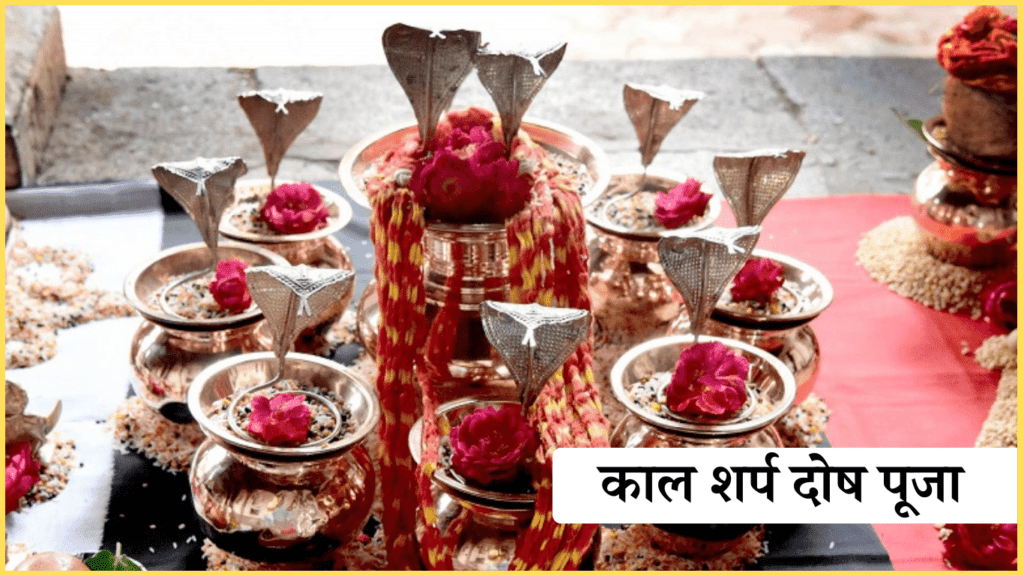
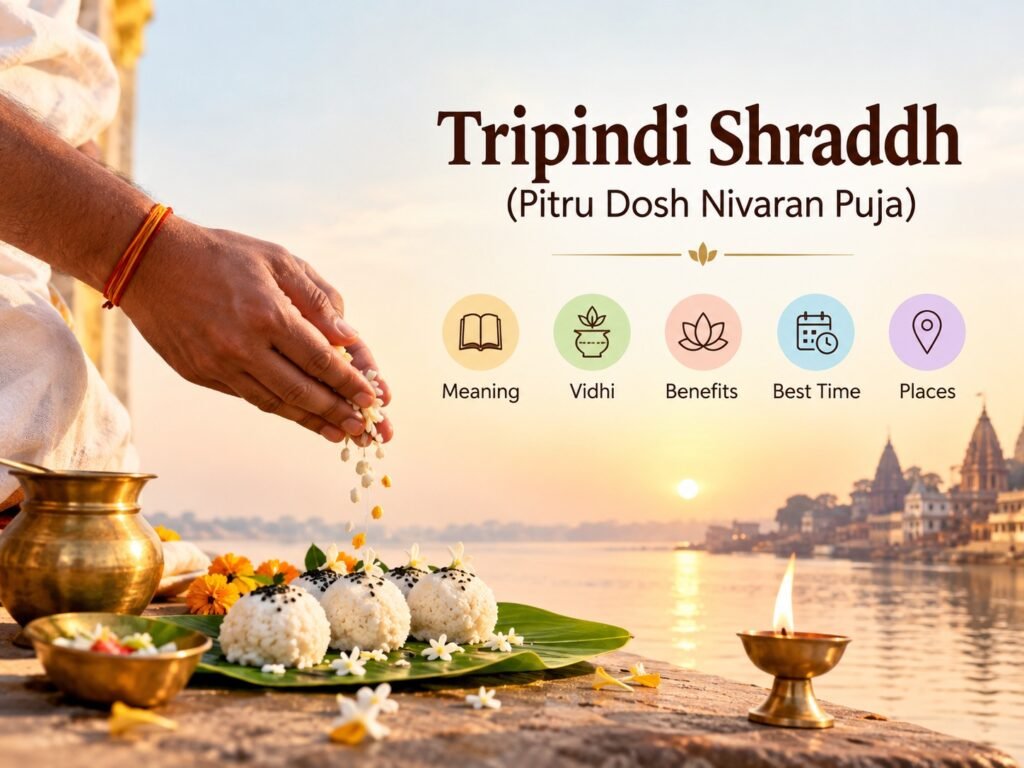
Many families face problems that have no clear reason. There may be constant tension at home, delay in marriage, no child, repeated illness or sudden losses. In Hindu tradition, some of these troubles are linked to ancestors or departed souls who have not found peace. For this, the scriptures describe a special ritual called Tripindi Shraddh. Many people search for it as Pitru Dosh Nivaran Puja, and Tripindi Shraddh is the main shastriya vidhi done for it.
In this guide, you will learn what Tripindi Shraddh is, who needs it, the complete Tripindi Shraddh vidhi, the difference between Tripindi Shraddh and Narayan Bali, the right time to perform it, and the holy places where it is done, including Pishach Mochan in Varanasi, Pretshila in Gaya and Trimbakeshwar in Nashik.
What Is Tripindi Shraddh?
Shraddh is the act of offering pind (rice or grain balls), water and food to our ancestors with faith, according to the rules of dharma. It is believed that a Shraddh done properly satisfies the ancestors, and in return they bless the family with long life, good name, strength, good health and peace.
Tripindi Shraddh is a special type of Shraddh known as Kamya Shraddh, meaning a Shraddh done with a specific purpose in mind. It is performed to free the family from troubles caused by souls who are stuck in the preta (ghost) or pishach state and have not received a good path after death.
Traditional texts explain that a soul can enter this state in many ways: through suicide, accident, untimely death, violent death, or when the last rites (Aurdhvadehik Sanskar) were not done as per shastra. Such souls are believed to wander in hunger and thirst, and sometimes cause physical or mental trouble, or obstacles in having children, to people connected to them by family or past relations. This is called Pret Badha or Pitru Badha.
Tripindi Shraddh is done to give these souls peace and a higher path. It is also believed that once they are freed, they stop being obstacles and instead help the person who performed the ritual.
What the Shastras Say About Tripindi Shraddh
Shraddh done to please the ancestors is called Pitru Yajna in the scriptures. The shastras say that it is the ancestors who protect their family line, so they must be kept satisfied through Shraddh. Among the many types of Shraddh, three are known as special ones: Narayan Bali, Nagbali and Tripindi Shraddh.
The classical text Shraddha Kamalakara advises that Shraddh for the ancestors should be performed as many as 72 times in a year. In today’s busy life, very few families can follow this, and gaps in Shraddh are common. Traditional belief holds that when the Shraddh of ancestors is not done for three continuous years, the departed soul can be pushed into the preta state. Tripindi Shraddh is prescribed to remove such a burden from the family.
The detailed method of Tripindi Shraddh is described in the well-known Shraddh text Shraddh Chintamani. The ritual explained below follows this traditional method.
Why Is It Called “Tripindi”?
“Tri” means three and “pind” means the offering ball. In this ritual, three separate pinds are made for three types of souls in the preta state, based on the three gunas:
- Sattvik souls, connected with Lord Vishnu and believed to stay in the higher region (dyuloka). Their pind is made from barley flour.
- Rajasik souls, connected with Lord Brahma and believed to stay in the space between earth and sky. Their pind is made from rice flour.
- Tamasik souls, connected with Lord Rudra (Shiva) and believed to stay on the earth. Their pind is made from sesame flour.
This is why the ritual is called Tripindi Shraddh. In a normal Shraddh, the pind is made of kheer or rice, but in this ritual the materials are different for each of the three.
Who Needs Tripindi Shraddh?
According to traditional beliefs, Tripindi Shraddh is advised in these situations:
- Someone in the family died by accident, suicide or an untimely death
- Shraddh of ancestors was not done properly, or was skipped for three continuous years
- Constant fights, unrest, poverty or illness in the home without a clear cause
- Delay in marriage or difficulty in having children
- Signs of Pitru Dosh in the kundali. Astrologers often point to conjunctions such as Saturn with Rahu or Ketu, an afflicted Sun, or an afflicted ninth house
- A feeling of negative energy or disturbance in the family that has no explanation
One important point from the shastric tradition: since the exact name and gotra of the troubling soul is often not known, the ritual is done for “unknown name and gotra” (Agyat Naam Gotra). Because of this, many scholars say that Tripindi Shraddh is useful for almost every family, as we can never be sure whether someone in our extended lineage passed away in a troubled way. It is described as beneficial in every way and is done to remove any hidden Pitru Badha.
Is Tripindi Shraddh the Same as Pitru Dosh Nivaran Puja?
Many people do not know the name Tripindi Shraddh. They search for the ritual by the problem they are facing, using words like Pitru Dosh Nivaran Puja or Pitra Dosh puja. This is natural, because Pitru Dosh is a broad term. It is linked with the kundali (for example the ninth house, the Sun, Saturn, Rahu and Ketu) and with unrest in the ancestral line, and it can be treated with more than one remedy, such as Narayan Bali, Nagbali, Pind Daan at Gaya and Tarpan.
Tripindi Shraddh is the main shastriya vidhi done to remove Pitru Badha and Pret Badha, which are believed to be the ritual cause behind such troubles. So when a pandit speaks of a puja for Pitru Dosh, Tripindi Shraddh is very often the ritual that is meant. In simple words, Pitru Dosh is the name of the problem, and Tripindi Shraddh is the scriptural method to remove it.
Which remedy is right for your family depends on your family history and the kind of trouble you face. An experienced pandit can guide you after understanding your case.
Who Can Perform Tripindi Shraddh?
Traditionally, the ritual is performed by the family’s male descendants, usually the son. Married couples also perform it together. Different traditions have slightly different rules about the eldest or youngest son and about unmarried persons, so it is best to confirm this with your acharya before booking.
Tripindi Shraddh Vidhi: Step by Step
The following is a short outline of how Tripindi Shraddh is performed according to traditional ritual guidance.
- Sankalp and holy bath. The person goes to the tirtha and takes a bath with a sankalp (resolve) to gain the right to perform the Shraddh.
- Tarpan. Water offerings are made to the devas, rishis, divine ancestors and one’s own ancestors. This is followed by worship of the Sun and salutations to all directions.
- Worship of Vishnu. Shaligram or a murti of Lord Vishnu is worshipped as per vidhi.
- Main pratigya sankalp. The main resolve of the Shraddh is taken.
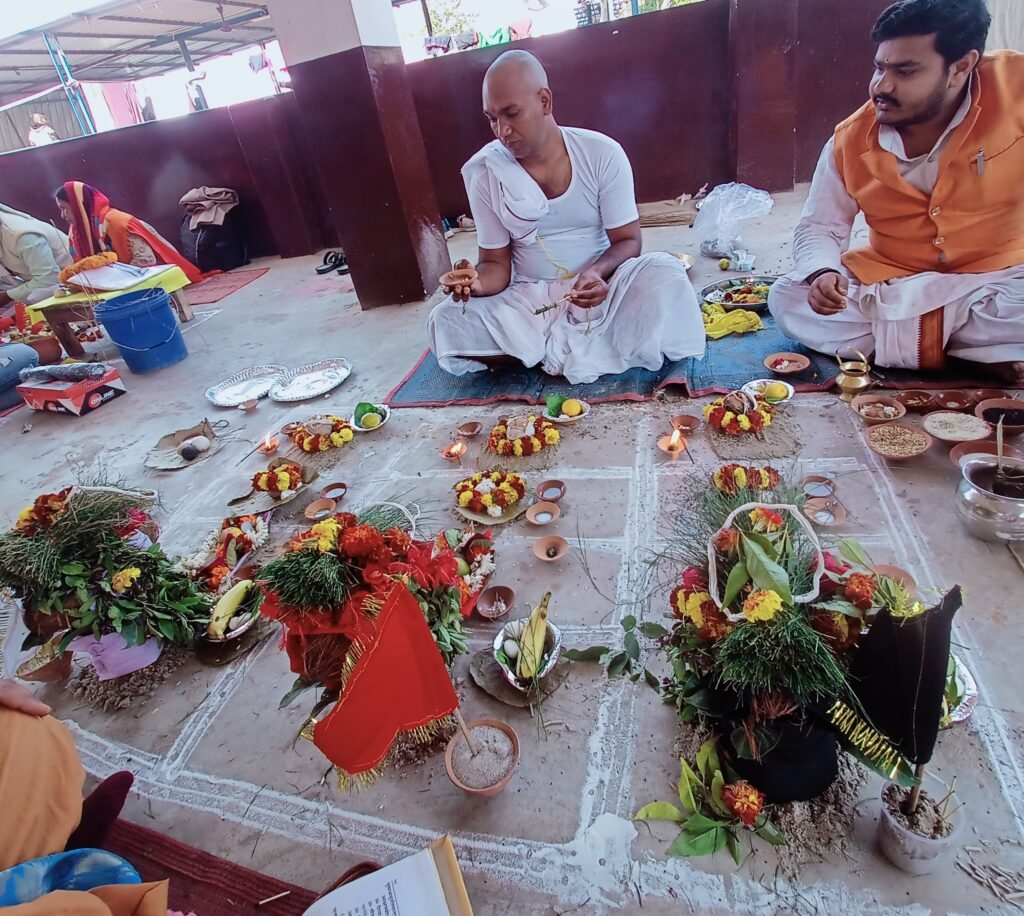
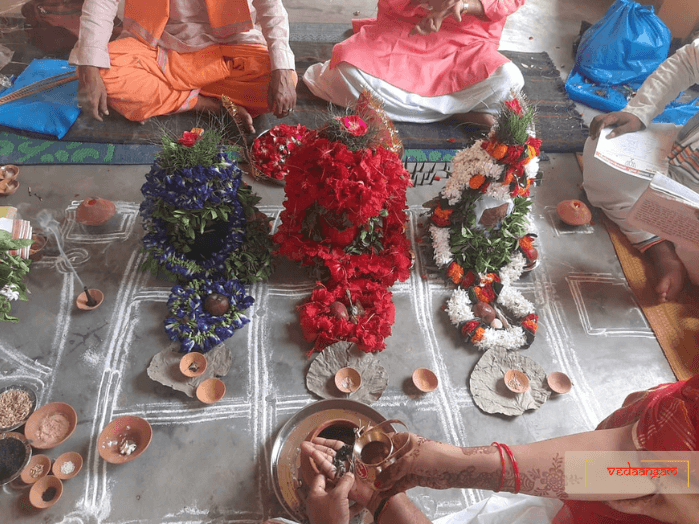
- Establishing three kalashas. Three separate kalashas are placed for Lord Vishnu, Brahma and Rudra. The deities’ images are given Pran Pratishtha and placed on the kalashas.
- Recitation of Suktas. Three Brahmins are selected to recite the Vishnu Sukta, Brahma Sukta and Rudra Sukta, while the kalashas are consecrated with mantras.
- Seating for the souls. Three seats are placed in front of the three kalashas for the sattvik, rajasik and tamasik souls of unknown name and gotra.
- Offering of three pinds. Pinds of barley flour, rice flour and sesame flour are offered separately.
- Special arghya. After the water offering, a special arghya is given with a citron (matulinga) for the sattvik, lime (jambira) for the rajasik and dates (kharjura) for the tamasik souls.
- Tarpan of pinds. Tarpan is done with conch water on Shaligram or Vishnu murti and on the three pinds.
- Gau Daan and Abhishek. Cow donation is done for completeness of the tarpan, and the pinds are bathed with water from the three kalashas.
- Daan. Cloth, a water pot with sweet water, footwear and umbrella are donated with dakshina. After this, Moksha Dhenu Daan, Til Patra Daan and Chhaya Patra Daan (ghee in a bronze vessel) are done.
- Brahmin bhojan and visarjan. Brahmins are fed, the souls are given a respectful farewell, dakshina is given to the acharya, and prayer is made to Lord Vishnu.
- Final offering. The ritual ends by pouring water mixed with sesame, or milk, at the root of a peepal tree.
Items commonly donated during the ritual include gold, silver, copper, a cow, rice or barley, black sesame, urad dal, an umbrella and footwear.
Tripindi Shraddh vs Narayan Bali: What Is the Difference?
People often confuse these two rituals. Here is a simple comparison.
| Point | Tripindi Shraddh | Narayan Bali |
| Main purpose | Removes troubles in the family lineage caused by souls in the preta state | Atonement for an unnatural death, so that the last rites of that person become complete |
| Whose soul | Souls of unknown name and gotra, from one’s own or other families | A known person of one’s own family and gotra who died an unnatural death |
| Number of souls | Three types of souls: sattvik, rajasik and tamasik | Mainly one soul |
| Nature of ritual | Kamya Shraddh with three pinds | Deity-focused ritual, mainly for one preta |
| When needed | Unexplained family problems, Pitru Badha, Pitru Dosh | Death by accident, suicide or other unnatural causes in the family |
In short, Narayan Bali is done to liberate a specific family member who died in a troubled way, while Tripindi Shraddh is done to remove problems in the family line caused by any such souls. Narayan Bali is also spoken of together with Nagbali, and the scriptures name Narayan Bali, Nagbali and Tripindi as three special Shraddhas for ancestors. If you are unsure which one your family needs, speak to an experienced pandit who can guide you based on your family history.
Best Time to Perform Tripindi Shraddh
Since it is a Kamya Shraddh, the texts give preferred timing:
- The main months are Kartik, Margashirsha, Pausha and Magha.
- In these months, the preferred tithis are Panchami, Ashtami, Ekadashi and Trayodashi of both Shukla and Krishna Paksha.
- Amavasya is known as the tithi of the ancestors, and the period of Pitru Paksha is also important for ancestor rituals.
- Do not perform it during Navratri.
- Do not do Tripindi Shraddh and Tirtha Shraddh on the same day. If time is short, complete the Tripindi Shraddh first and then do the Tirtha Shraddh.
- If a family is suffering from a severe problem, the ritual can be done at once without waiting for a particular month or tithi.
Because dates change every year with the Panchang, please confirm the exact muhurat with your pandit before booking.
Where to Perform Tripindi Shraddh: Holy Places
The scriptures say Tripindi Shraddh is best done at a holy tirtha. The most respected places are:
- Pishach Mochan, Kashi (Varanasi): A famous tirtha in Varanasi, known for freeing souls from the pishach and preta state.
- Gaya: Gaya is the most famous place for Pind Daan and Tripindi Shraddh is performed at three places here: Pretshila, Gaya Koop and Dharmaranya Vedi..
- Trimbakeshwar, Nashik: The Jyotirlinga temple of Lord Shiva at Trimbakeshwar is widely known for Tripindi Shraddh and Narayan Nagbali, and many families travel there for this ritual.
- Other places: Any sacred river or lake bank can be used. If none is available, the ritual can be done near a Shiva temple or near a Tulsi or peepal (ashvattha) tree.
Why Pishach Mochan in Varanasi Is Special
The name Pishach Mochan itself means “the one who frees from the pishach state”. Kashi is called the city where Lord Shiva himself gives liberation, and Pishach Mochan Tirtha is the place in Kashi specifically known for this purpose. Traditional ritual guidance lists Pishach Mochan Tirtha in Kashi as the first choice for Tripindi Shraddh, followed by Pretshila in Gaya.
Many families choose Pishach Mochan because it combines the sanctity of Kashi with a place directly connected to the release of wandering souls. For families across India and abroad who cannot travel easily, this is also a place where the ritual can be performed by experienced Kashi pandits on their behalf.
Tripindi Shraddh at Pishach Mochan with Vedaangam
Vedaangam is a Varanasi-based puja service where Tripindi Shraddh in Varanasi is performed by experienced pandits at Pishach Mochan as per shastric vidhi.
- In-person: If you can travel to Varanasi, you can sit for the ritual yourself with the pandit guiding each step.
- Online: If you live in another city or country, the ritual can be performed in your name by our pandits, and you can take part through video.
To book, visit vedaangam.com and use the booking form, or contact us on WhatsApp. Our team will help you choose the right date and guide you on the right ritual for your family.
Frequently Asked Questions
1. What is Tripindi Shraddh in simple words?
It is a special Shraddh in which three pinds are offered for three types of souls who are in the preta or pishach state, so that they get peace and stop causing obstacles in the family.
2. Who should do Tripindi Shraddh?
Families who have had untimely or unnatural deaths, whose ancestors’ Shraddh was not done for three years, who face unexplained troubles, or who have Pitru Dosh in their kundali.
3. What is the difference between Tripindi Shraddh and Narayan Bali?
Narayan Bali is for the liberation of a known family member who died unnaturally. Tripindi Shraddh is for souls of unknown name and gotra who may be causing trouble in the family.
4. What is Pitru Dosh Nivaran Puja?
Pitru Dosh Nivaran Puja is a general name for rituals done to remove Pitru Dosh. Tripindi Shraddh is the main shastriya vidhi done for it, along with other remedies such as Narayan Bali, Nagbali and Pind Daan, depending on the case of the family.
5. Which puja is best for Pitru Dosh?
It depends on the cause. Tripindi Shraddh is done for Pitru Badha and Pret Badha caused by souls of unknown name and gotra. Narayan Bali is for a known family member who died an unnatural death, and Pind Daan at Gaya is for the peace of ancestors in general. An experienced pandit can guide you after knowing your family history.
6. Can Tripindi Shraddh be done online?
Yes. If you cannot travel, the ritual can be performed in your name by pandits at a holy place like Pishach Mochan, and you can join through video.
7. Where is the best place to perform Tripindi Shraddh?
Pishach Mochan (Varanasi), Pretshila (Gaya) and Trimbakeshwar (Nashik) are the most respected places. It can also be done on the bank of any holy river.
8. When should Tripindi Shraddh be done?
Preferably in the months of Kartik, Margashirsha, Pausha and Magha, on the tithis mentioned above. It should not be done in Navratri. In case of severe problems, it can be done at any time.
9. Can Tripindi Shraddh and Tirtha Shraddh be done on the same day?
It is advised to do them on separate days. If time is short, do Tripindi first and Tirtha Shraddh after.
10. What is donated in Tripindi Shraddh?
Traditionally gold, silver, copper, cow, rice or barley, black sesame, urad, umbrella and footwear, along with dakshina to the Brahmins.
Conclusion
Tripindi Shraddh is a deeply respected shastric ritual for bringing peace to restless ancestors and removing hidden Pitru Badha from a family. Done with faith, at the right time and at a holy place like Pishach Mochan, Pretshila or Trimbakeshwar, it is believed to bring peace, protection and progress to the whole family.
If you want to perform Tripindi Shraddh at Pishach Mochan, Varanasi, in person or online, contact Vedaangam and our pandits will guide you at every step.