There are certain afflictions in a Kundali that a competent astrologer will immediately pause at. Pitra Dosh is one of them. Not because it is rare but because it is serious, and because most people who carry it do not understand what it actually means. They have heard the term. A relative may have mentioned it. A pandit may have flagged it during a Kundali reading. But the understanding rarely goes deeper than that.
The result is that remedies are attempted without clarity, and the dosh remains unresolved for years sometimes across generations. This guide is for those who want to understand the matter properly, because the pitra dosh nivaran puja, when done correctly and with genuine knowledge of what you are doing, carries consequences that are not trivial.
What Is Pitra Dosh: The Meaning According to Vedic and Puranic Texts
The word Pitra refers to the ancestors specifically those who have departed from this world and entered Pitru Loka. The Garuda Purana, which devotes its entire Pretakhanda to the state of souls after death, establishes the foundational principle: the souls of the departed require nourishment and ritual acknowledgment from their living descendants. Without this, they remain in a state the text calls Atripti deep unsatisfaction.
The Manusmriti (3.70) states plainly: “Pitru yagyas tu tarpaNam” the Pitru Yajna is nothing but Tarpan. This places the offering to ancestors at the level of a Vedic yajna. It is one of the Pancha Mahayajnas, the five great duties of a householder. It is not optional.
In Vedic astrology, Pitra Dosh in the Kundali appears most prominently when the Sun and Rahu are conjunct, particularly in the ninth house, which governs the father, ancestors, and dharma. Ketu aligned with the Sun in the second, eighth, or tenth house also indicates this affliction. The lord of the ninth house placed in the sixth, eighth, or twelfth house further strengthens the diagnosis. But Pitra Dosh is not merely an astrological position it is a reflection of a spiritual debt that has not been settled, and the planets are simply the signal.
Why Pitra Dosh Happens: The Account From the Garuda Purana
The Garuda Purana’s Pretakhanda describes in precise detail what happens to a soul after death and the conditions under which it becomes a source of Pitra Dosh for the living.
When a soul departs, it enters a transitional state as a Preta a disembodied spirit that still carries the imprints of earthly desires and attachments. The Garuda Purana explains that this subtle body experiences hunger and thirst, and it is the Pind Daan and Tarpan performed by the living that provide the specific nourishment this subtle body requires. Without these offerings, the soul cannot progress through the stages of Pitru Loka and remains in deprivation.
The text identifies several specific causes of Pitra Dosh:
- An ancestor who died through accident, suicide, drowning, fire, or violent death is trapped in what the Garuda Purana calls Preta Yoni a ghostly state from which it cannot exit through regular Shraddha alone. This category specifically requires Narayan Bali Puja, which Vedaangam performs at Varanasi with qualified pandits.
- When Shraddha has not been performed for three or more consecutive years, the accumulated debt compounds into what the Garuda Purana calls a specific category of ancestral obligation. The prescribed remedy in this case is Tripindi Shraddha a distinct ritual separate from regular Shraddha.
- If family property was acquired through wrongdoing, if the dying person’s last wishes were not honoured, or if elderly parents were mistreated in their final years these too become causes of Pitra Dosh.
The living family then experiences the consequences: repeated miscarriages, delayed marriages, failure of children despite sincere effort, unexplained financial losses, and mental disturbances that no doctor can account for. The Garuda Purana does not treat these as unconnected misfortunes it treats them as symptoms of a specific spiritual debt.
Do I Have Pitra Dosh: Signs and Kundali Indicators
Dreams of deceased relatives in a dishevelled state appearing hungry or asking for water are specifically mentioned in the Garuda Purana as a sign that the departed soul is not at peace. This is not a folk belief. It is a Puranic indicator that should prompt a proper Kundali examination.
The patterns that appear consistently in affected families include:
- Persistent obstruction at critical life milestones marriages broken at the last moment
- Sons not producing children despite no medical cause
- Business ventures that collapse without clear reason across generations
- Recurring illness in the family that targets the same organ or system across generations
- Unexplained financial instability despite sincere effort and capability
None of these alone confirms Pitra Dosh. Together especially when the Kundali reflects the relevant planetary positions they do. A qualified Jyotishi will look for the Sun-Rahu conjunction, for the affliction of the fifth house which governs children, for Jupiter severely weakened or afflicted, and for multiple malefic planets in the fifth house without benefic influence. These combinations must be read together, not in isolation.
The Pitra Dosh Nivaran Puja: Process and Vidhi
The pitra dosh nivaran puja is not a single ritual. It is a set of prescribed actions, each serving a specific function in addressing the spiritual debt.
Tarpan
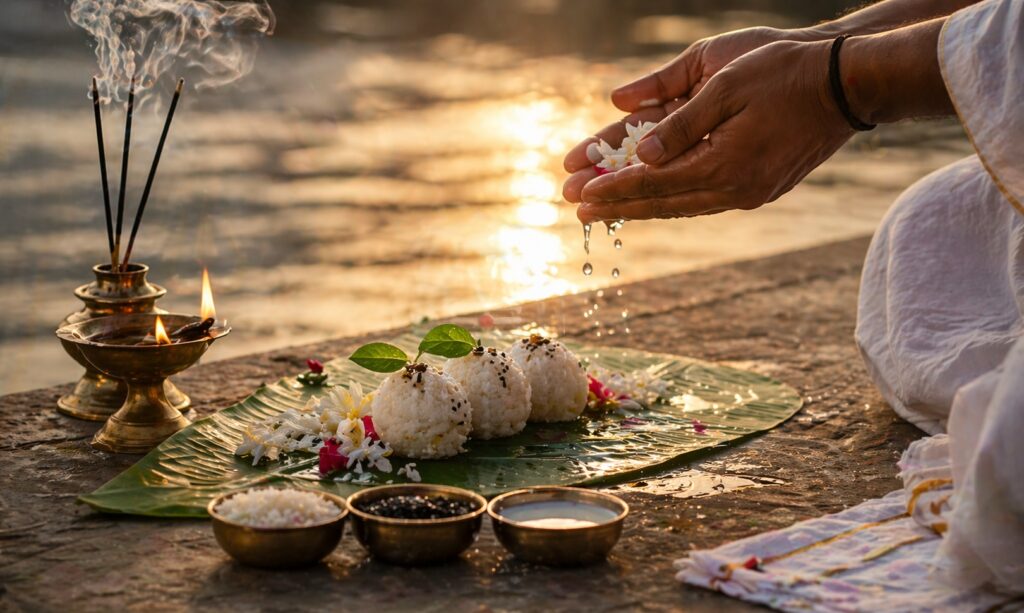
Tarpan is the offering of water mixed with sesame seeds, kusha grass, and barley to the departed ancestors. It is performed by the male descendant facing south, using the Pitru Tirtha the space between the index finger and the thumb of the left hand with the sacred thread worn in the Apasavya manner on the right shoulder. The traditional Pitra Tarpan mantra recited during this offering is:
“Om Agnishvattaah pitarastripyantamidam jalam, tebhyah swadha, tebhyah swadha, tebhyah swadha.”
This mantra, along with the invocation of Soma, Yama, Aryama, and the Vasu-Rudra-Aditya forms of the ancestors, constitutes the complete Pitra Tarpan as performed in the North Indian Purnimanta tradition.
Shraddha Puja
Shraddha is the full ritual feeding. The procedure involves Sankalpa, followed by Tarpan, then Pinda Daan the offering of rice balls mixed with sesame seeds, barley flour, honey, and ghee and finally Brahmin Bhojan with Dakshina. The Manusmriti (3.122-286) provides the most comprehensive framework for Shraddha, specifying who must perform it, when, and with what materials.
Vedaangam performs Shraddha Puja and Gaya Shradh at the most sacred tirthas with experienced pandits, complete ritual materials, and documentation of the puja provided to the family.
Narayan Bali
Narayan Bali is specifically prescribed when an ancestor died through unnatural means. The Garuda Purana is direct on this: when a soul is trapped in Preta Yoni through violent or untimely death, regular Shraddha offerings are “destroyed in space” and do not reach the soul. Narayan Bali creates a symbolic new body for the ancestor, performs the funeral rites afresh, and facilitates release from the Preta state.
If your family has had an ancestor who died through accident, suicide, or violent means and proper rites were not performed at the time, Narayan Bali Puja at Varanasi is the prescribed remedy according to the Garuda Purana.
Tripindi Shraddha
Tripindi Shraddha is the prescribed remedy when Shraddha has not been performed for three or more consecutive years a condition specifically identified in the Garuda Purana as one where the ancestral debt has compounded beyond resolution through ordinary Tarpan. Vedaangam performs Tripindi Shraddha at both Varanasi and Gaya, depending on your family’s situation and the pandit’s recommendation.
Mantra for Pitra Dosh Nivaran: What to Chant and How
The traditional Pitra Tarpan mantras invoke the Pitras across their three forms. The Vasu form represents the father, the Rudra form the grandfather, and the Aditya form the great-grandfather. The mantra sequence is:
“Om kavyavadanlastripyatam idam jalam, tasmai swadha, tasmai swadha, tasmai swadha. Om Somastripyatam idam jalam, tasmai swadha, tasmai swadha, tasmai swadha. Om Yamastripyatam idam jalam, tasmai swadha, tasmai swadha, tasmai swadha.”
Following these invocations, the practitioner offers water with sesame seeds three times per ancestor while pronouncing the ancestor’s name, gotra, and relationship.
The Manusmriti (9.138) establishes the theological importance of the son’s role: “Punnamno narakad yasmat pitaram trayate sutah, tasmat putra iti proktah swayameva swayambhuva” “Because the son saves the father from the hell called Put, Swayambhu himself has named him Putra.” This is the scriptural basis for why the male descendant is the primary performer of Pitra rites.
For a daily practice, the Pitra Gayatri beginning with “Om Pitru devabhyo vidmahe” can be recited on every Amavasya with the offering of water and sesame seeds facing south. This, performed consistently, is recognised across the Smriti tradition as the minimum Pitru obligation.
When to Do Pitra Dosh Puja: Auspicious Tithis in the Purnimanta Calendar
The most important period for pitra dosh nivaran puja is Pitru Paksha. In the Purnimanta Panchang followed across North India, Pitru Paksha falls in the Krishna Paksha of Bhadrapada month, running from Purnima through to Mahalaya Amavasya. This sixteen-day period is specifically designated in the Garuda Purana for ancestral rites.
Within Pitru Paksha, each tithi corresponds to a category of ancestor. The key dates and their significance are:
- Tithi matching the ancestor’s death date The Shraddha performed on this tithi carries the highest efficacy. Vedaangam’s pandits perform Pind Daan at Gaya on the specific tithi as per your family’s requirement.
- Mahalaya Amavasya The most powerful single day. Rites for ancestors whose exact tithi is unknown are also accepted on this day, which is why it draws the largest number of families to the tirthas.
- Every Amavasya throughout the year Valid for Tarpan at all tirthas.
- Solar and Lunar Eclipses Traditional ritual texts state that Tarpan performed during an eclipse carries merit equivalent to Shraddha performed for a thousand years.
- Vaishakh Amavasya Specifically praised in the Padma Purana: “Vaishakhe tu Amavasya, snana danam mahaphalam” bathing and performing ritual charity on this day grants immense merit.
Where to Perform Pitra Dosh Puja: The Sacred Tirthas
Not every location carries equal merit for ancestral rites. The Garuda Purana makes a statement that leaves no room for ambiguity: even if a man performs Shraddha at Pushkar, Kurukshetra, Prayag, Gangasagar, and all other tirthas combined, the merit does not equal one-sixteenth of the merit obtained at Gaya.
Gaya, Bihar The Supreme Tirtha for Pind Daan
The scriptural basis is rooted in the Vayu Purana’s Gaya Mahatmya. Lord Vishnu placed his foot upon the demon Gayasura, concentrating immense liberated spiritual energy at the Vishnupad site. The Kurma Purana (34/7-8) states that whoever performs Pind Daan at Gaya liberates seven generations on the paternal side and seven on the maternal side. The Gaya Mahatmya further specifies that Pind Daan at Vishnupad liberates 101 generations.
Vedaangam provides complete Pind Daan Puja Services in Gaya with qualified pandits, ritual materials, and a complete Gaya Shradh experience. If you require a Tamil-speaking pandit for the ritual, Vedaangam also offers a Tamil Pandit for Pind Daan in Gaya and Varanasi one of the few services of this kind available on the platform.
For families who cannot travel, the Gaya Shradh Package includes all ritual arrangements performed on your behalf with live video and puja documentation sent to you.
Prayagraj Triveni Sangam and the Akshayavat
The Padma Purana classifies Prayagraj as a Mahatirtha. The Akshayavat at Prayagraj is specifically associated with ancestral rites offerings made there are described as Akshaya, meaning they can never be diminished or forgotten by the ancestors. Lord Rama, Sita, and Lakshmana performed Shraddha for King Dasharatha at Gaya. The Mahabharata records that the Pandavas also performed ancestral rites at Prayagraj.
Kashi (Varanasi) The Complete Tirtha for All Pitru Rites
The Skanda Purana’s Kashi Khanda states that a person who dies in Kashi receives Taraka Mantra from Lord Shiva. For the living who perform ancestral rites, Varanasi is a tirtha where multiple pitru services can be arranged at once. Vedaangam performs Narayan Bali at Varanasi, Tripindi Shraddha at Varanasi, and Tarpan at the Ganga making it a practical choice for families who need multiple rituals arranged in a single visit.
Badrinath Brahma Kapal
The Skanda Purana mentions Brahma Kapal at Badrinath as a place where Shraddha can be performed for ancestors seeking liberation. It is a site of exceptional sanctity in the Himalayan tirtha tradition.
Benefits of Pitra Dosh Nivaran Puja: What the Scriptures Promise
The Garuda Purana states that satisfied ancestors bestow upon their descendants long life, prosperity, children, and liberation from accumulated debt. The Padma Purana adds that the satisfied pitras bestow wealth, sons, and an uninterrupted lineage upon the performer.
A specific passage in the Garuda Purana states: with every step a son takes toward Gaya, his ancestors ascend a step toward heaven and this act has the capacity to save ten past and ten future generations of the family. This is the scriptural basis for why a single journey to Gaya is considered a once-in-a-lifetime sacred obligation.
The Manusmriti (3.131) states: “Dhanyam yashasyam Ayushyam swargam shatruvinashanam, santarakam cheti shraddhamahoor maneekshinah” Shraddha bestows wealth, fame, longevity, heaven, destruction of enemies, and progeny. These are not vague blessings. They are named outcomes tied to a specific ritual obligation.
How to Book Pitra Dosh Nivaran Puja on Vedaangam
Vedaangam offers all major pitru puja services both online and at the tirthas:
- Pind Daan at Gaya Complete puja at Vishnupad with qualified pandits
- Gaya Shradh Package Full Shraddha arrangements at Gaya including travel, stay, and ritual coordination
- Tripindi Shraddha in Gaya For families where Shraddha has not been performed for three or more years
- Tripindi Shraddha in Varanasi Same remedy available at the Kashi tirtha
- Narayan Bali Puja in Varanasi For ancestors who died through unnatural or violent means
- Tamil Pandit for Pind Daan in Gaya and Varanasi For Tamil-speaking families requiring a pandit in their tradition
To book, visit Vedaangam.com or send a WhatsApp message to the team with your family details, the nature of the dosh if known, and your preferred dates. The team will respond with the appropriate puja recommendation and complete cost information.
Frequently Asked Questions
What is pitra dosh puja?
Pitra dosh puja is a set of Vedic rituals performed to resolve the disturbance caused by unsatisfied ancestral souls. As described in the Garuda Purana, it includes Tarpan, Shraddha, and Pind Daan, performed on specific tithis as prescribed in the Puranic and Smriti tradition, to bring peace to the departed souls and remove the obstacles their unsatisfied state creates in the lives of descendants.
When should pitra dosh puja be done?
The most auspicious period is Pitru Paksha in the Krishna Paksha of Bhadrapada month, as per the Purnimanta calendar. The tithi matching the ancestor’s death date carries the highest efficacy. Every Amavasya throughout the year is valid for Tarpan. Solar and lunar eclipses are also cited in traditional ritual texts as occasions where Tarpan performed is equivalent to Shraddha performed for a thousand years.
Where is the best place to perform pitra dosh puja?
Gaya in Bihar is the supreme tirtha for Pind Daan, explicitly stated as such in the Garuda Purana. The Kurma Purana (34/7-8) specifies that Pind Daan at Gaya liberates seven generations on the paternal side and seven on the maternal side. Varanasi is the preferred tirtha for Narayan Bali and Tripindi Shraddha. Prayagraj and Badrinath are the other principal tirthas for ancestral rites, each with specific scriptural sanction.
What is the cost of pitra dosh nivaran puja?
The cost depends on whether the puja is performed online or at a tirtha, and on the specific ritual required whether basic Tarpan, full Shraddha, Narayan Bali, or Tripindi Shraddha. Vedaangam offers transparent pricing with no hidden charges. Visit Vedaangam.com or contact the team on WhatsApp for a detailed quote.
What mantra should be chanted for pitra dosh nivaran?
The primary mantra used during Pitra Tarpan is the traditional invocation beginning with “Om Agnishvattaah pitarastripyantam idam jalam, tebhyah swadha” followed by the names of the Pitru devatas and the ancestor’s name and gotra. For a daily practice, the Pitra Gayatri recited on every Amavasya with sesame and water is the minimum prescribed observance.
What is the difference between Narayan Bali and Tripindi Shraddha?
Narayan Bali is performed specifically when an ancestor died through unnatural or violent means accident, suicide, drowning, or fire. The Garuda Purana prescribes it as the only ritual capable of releasing a soul trapped in Preta Yoni due to such a death. Tripindi Shraddha, by contrast, is prescribed when Shraddha has not been performed for three or more consecutive years, and the ancestral debt has compounded beyond what regular Tarpan can resolve. Both are available through Vedaangam’s pitru puja services.
Can pitra dosh nivaran puja be done online?
Yes. Vedaangam offers online puja where a qualified pandit performs Tarpan, Shraddha, and Pind Daan at the designated tirtha on your behalf. The ritual is performed with live video, and all puja documentation is provided to the family. Visit Vedaangam.com to book.